
BMW has long been celebrated for its high-performance diesel engines, combining power, efficiency, and engineering excellence. However, even the best engines wear out over time making reconditioning a smart choice to restore performance and longevity without the cost of a brand-new unit.
Two of BMW’s most popular diesel engines are the:
B47 (2.0L 4-cylinder): Found in models like the 320d, 520d, and X3 20d.
N57 (3.0L 6-cylinder): Powers the 330d, 535d, and X5 30d.
But which one offers better long-term reliability after reconditioning? This guide compares their common failures, rebuild costs, and post-reconditioning durability to help you make the best choice.
B47 and N57 Diesel Engines: A Quick Introduction
BMW’s diesel engine lineup has long been revered for its blend of performance and efficiency, with the B47 (2.0L 4 cylinder) and N57 (3.0L 6 cylinder) standing out as two of the most widely used powerplants.
B47 (2.0L 4 cylinder)
- Introduced: 2014 (successor to the N47)
- Models: Found in 18d, 20d, and 25d variants (e.g., 320d, 520d, X3 20d)
- Key Features:
- More compact and fuel-efficient than its predecessor
- Euro 6 compliant (better emissions control)
- Ideal for urban driving and fuel economy
N57 (3.0L 6 cylinder)
- Introduced: 2008 (upgraded over time, with versions like N57S, N57D30)
- Models: Powers 30d, 35d, and 40d variants (e.g., 530d, X5 35d, 740d)
- Key Features:
- Stronger torque output, better suited for high-performance and towing
- Later versions meet Euro 6 standards
- More complex but delivers smoother power delivery
Use Cases & Emissions
- B47: Best for daily commuting and efficiency
- N57: Excels in power-demanding scenarios (highway cruising, towing)
- Both engines have been updated to comply with Euro 6 emissions, making them cleaner and more reliable with proper maintenance.
BMW B47 vs N57 Diesel Engine Comparison:
| Category | B47 (2.0L Diesel Engine) | N57 (3.0L Diesel Engine) |
| Production Years | 2014–Present | 2008–2019 |
| Configuration | Inline-4 Turbocharged Diesel | Inline-6 Turbocharged Diesel |
| Common Models | 118d, 320d, 520d, X1 20d, X3 20d | 530d, 730d, X3 30d, X5 40d, 335d |
| Power Output Range | 114–231 hp | 204–381 hp |
| Torque Output | 270–500 Nm (depending on variant) | 450–740 Nm (depending on variant) |
| Block Material | Aluminium alloy | Aluminium-silicon alloy (more robust than B47) |
| Timing Chain Position | Rear-mounted (pre-2017 = common failure point) | Front-mounted (more accessible, fewer failure issues) |
| Reconditioning Suitability | Good for light use & urban driving | Excellent for performance & heavy loads |
| Reconditioned Lifespan | 180,000–220,000 miles | 250,000–300,000+ miles |
| Known Issues (Pre-Recon) | Timing chain stretch, DPF block, EGR clogging | Swirl flap failure, turbo issues, injector wear |
| Part Availability (UK) | High (newer engine family) | Medium (some parts discontinued but widely supported) |
| Fuel Economy (Average) | 50–65 mpg (real-world) | 38–48 mpg (real-world) |
| Ideal Use Case | City driving, fleet cars, economy | Motorway driving, towing, power-demanding use |
| Rebuild Cost (Estimated UK) | £2,000–£2,800 (standard rebuild) | £2,500–£3,500 (due to complexity & turbo config) |
| MHEV Compatibility | Available in newer versions | Not available (pre-dates hybrid integration) |
| Tuning Potential (Post-Recon) | Limited – economy-focused | High – supports remapping, hybrid turbos, etc. |
| ULEZ/Emissions Compliance | Euro 6 compliant (from 2015+) | Euro 5 or 6 (depending on model year) |
| Verdict | Best for modern daily use with low emissions | Best for power, durability, and long-term value |
Common Problems in B47 and N57 Engines
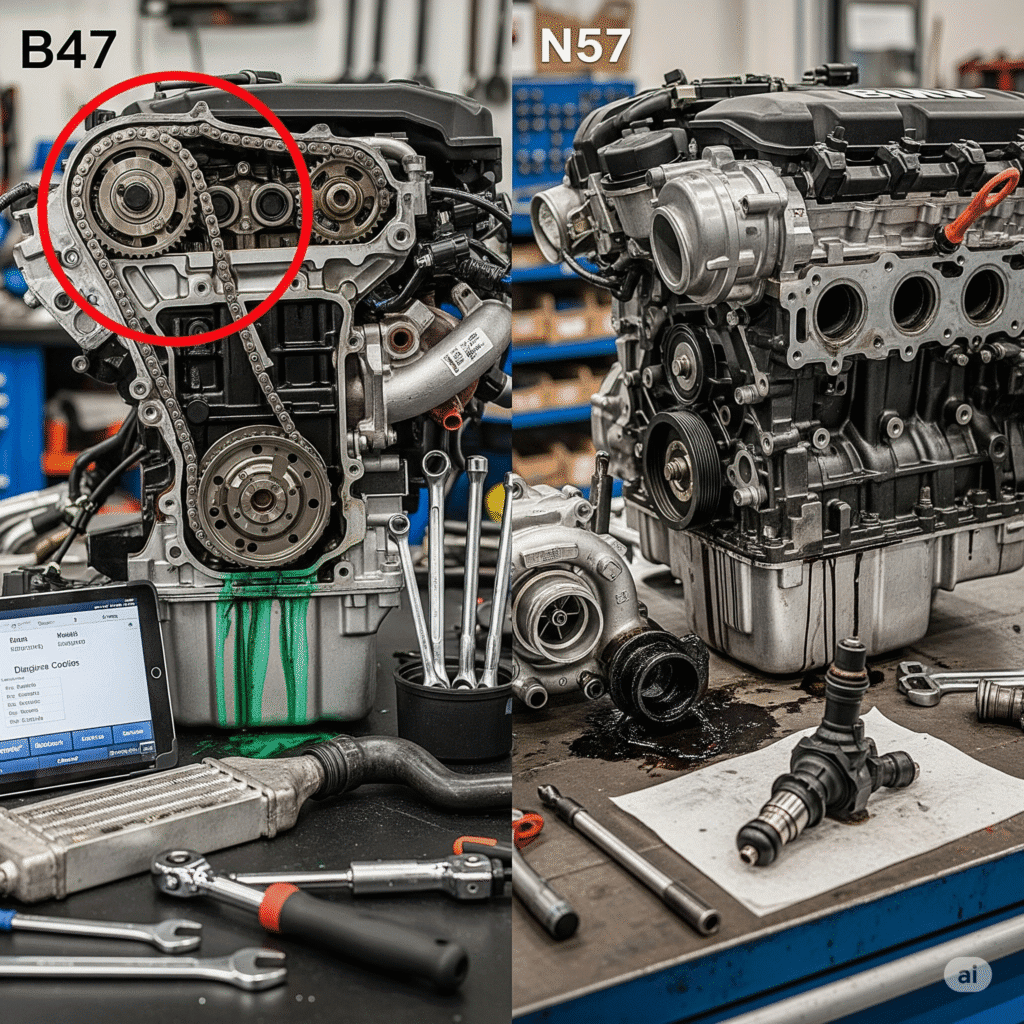
Before reconditioning, it’s crucial to understand the most frequent failures in BMW’s B47 and N57 diesel engines—and how they affect long-term reliability.
B47 (2.0L) Common Issues:
- Timing chain wear (stretching or tensioner failure → engine damage)
- EGR valve clogging (reduced power, poor fuel economy)
- DPF blockages (common in city driving, causes limp mode)
N57 (3.0L) Common Issues:
- Swirl flap failures (broken flaps can enter cylinders → catastrophic damage)
- Turbocharger wear (wastegate rattle, boost leaks)
- Injector leaks (causes misfires, carbon buildup)
Impact on Lifespan
Unrepaired, these problems lead to:
⚠ Premature engine wear
⚠ Costly secondary damage (e.g., snapped timing chains destroy cylinder heads)
⚠ Failed emissions tests & reduced performance
Before reconditioning, it’s crucial to understand the most frequent failures in BMW’s B47 and N57 diesel engines—and how they affect long-term reliability.
B47 (2.0L) Common Issues:
- Timing chain wear (stretching or tensioner failure → engine damage)
- EGR valve clogging (reduced power, poor fuel economy)
- DPF blockages (common in city driving, causes limp mode)
N57 (3.0L) Common Issues:
- Swirl flap failures (broken flaps can enter cylinders → catastrophic damage)
- Turbocharger wear (wastegate rattle, boost leaks)
- Injector leaks (causes misfires, carbon buildup)
Impact on Lifespan
Unrepaired, these problems lead to:
⚠ Premature engine wear
⚠ Costly secondary damage (e.g., snapped timing chains destroy cylinder heads)
⚠ Failed emissions tests & reduced performance
Why Reconditioning Beats Replacement
Cost-effective (saves 30–50% vs. new engine)
Addresses root causes (upgraded parts prevent repeat failures)
Extends engine life by 100,000+ miles when done properly
Which Engine Responds Better to Reconditioning?
When considering reconditioning, both the B47 and N57 have distinct advantages depending on your needs.
Parts Availability (UK Market)
- B47 (2.0L):
Newer design → Better OEM & aftermarket parts availability
Simpler construction → Lower rebuild complexity
Smaller engine → More stress per cylinder over time - N57 (3.0L):
Stronger cast-iron block → Handles high-mileage rebuilds better
Proven 6-cylinder durability → Preferred for tuned/high-load applications
Older design → Some parts (e.g., swirl flaps) becoming scarce
Cost Comparison
- B47 reconditioning: £2,500 £4,500 (lower labor time, more available parts)
- N57 reconditioning: £3,500 £6,000 (more components but stronger post-rebuild longevity)
Machine Shop Verdict
✔ B47: Ideal for cost-conscious owners needing a reliable daily driver
✔ N57: Best for performance/towing use where engine strength matters most
Longevity: Which Engine Lasts Longer After Reconditioning?
When choosing between a reconditioned B47 (2.0L) or N57 (3.0L), long-term durability is a key factor. Both engines have different strengths that impact their post-rebuild lifespan.
N57 (3.0L) Built for Endurance
- Cast-iron block construction → Handles high torque and stress better
- Longer service intervals (when properly maintained)
- Proven 300,000+ mile cases in well-maintained 530d/X5 models
- Tuning impact: Handles moderate remaps well, but aggressive tuning (400+ hp) accelerates wear
B47 (2.0L) Efficient but Less Robust
- Aluminum block → Lighter but less durable under heavy loads
- Typical lifespan after rebuild: 180,000–220,000 miles
- Tuning impact: Pushing beyond 220–250hp risks turbo & timing chain longevity
UK Mechanic & Forum Feedback
- N57 preferred for high-mileage drivers (taxis, motorway cruisers)
- B47 better for city use (lower fuel costs, but shorter lifespan under strain)
- Best longevity practice:
- Regular oil changes (every 8–10k miles)
- Timely EGR/DPF maintenance
- Avoid aggressive tuning without supporting mods
Final Verdict: B47 or N57?
The N57 (3.0L) wins for raw durability and performance, making it ideal for high-mileage drivers, towing, or tuning. Meanwhile, the B47 (2.0L) is the budget-friendly choice, offering better fuel efficiency and lower rebuild costs—perfect for urban commuting.
Choose based on your needs:
- N57 if you prioritize longevity & power
- B47 if you want affordability & daily efficiency
Before buying a reconditioned engine:
Verify warranty coverage (12–24 months ideal)
Inspect service history & rebuild documentation
Check for upgraded parts (timing chains, turbos, injectors)
Conclusion:
Both the B47 and N57 are excellent engines when properly reconditioned—your choice depends on priorities.
- N57 (3.0L) Best for power, towing, and long-term reliability
- B47 (2.0L) More fuel-efficient and cost-effective for daily driving
For the best results, source your reconditioned engine from a trusted UK specialist with a solid warranty and proven rebuild quality.
FAQs
1. Is the B47 timing chain issue fixed in later models?
Yes, BMW improved the timing chain system in post-2016 B47 engines, reducing failure risk. However, regular oil changes remain critical.
2. Can N57 engines be tuned safely after reconditioning?
Yes, but moderately (up to ~350hp). Ensure the rebuild included upgraded pistons and con rods for reliability.
3. Which engine is cheaper to recondition in the UK?
The B47 (typically £2,500–£4,500) costs less than the N57 (£3,500–£6,000) due to simpler design and parts availability.
4. Does the B47 use AdBlue, and is it reliable?
Yes, most Euro 6 B47s use AdBlue. The system is generally reliable but requires quality DEF fluid to avoid injector clogs.
5. Which engine has better resale value after reconditioning?
The N57 its 6 cylinder prestige and longevity appeal more to buyers.