
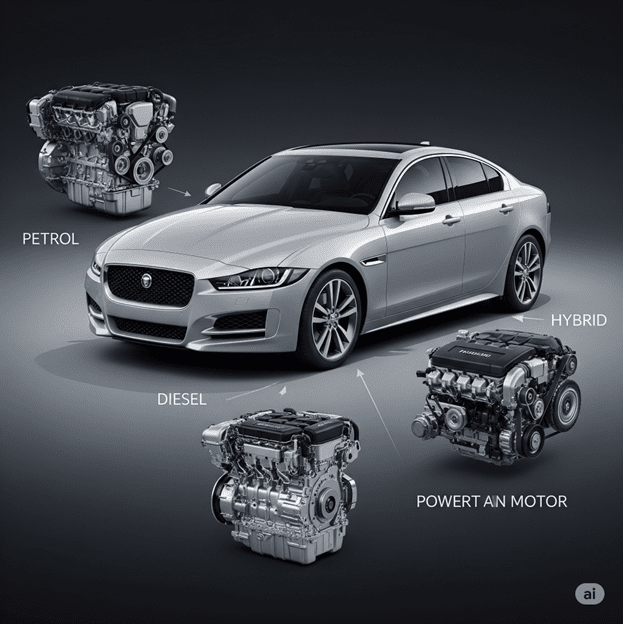
Jaguar XE has firmly established itself as a dynamic contender in the compact executive saloon segment, rivalling the likes of the BMW 3 Series and Audi A4. Renowned for its stunning design, agile handling, and cutting-edge technology, the XE’s true heart lies in its diverse range of advanced engines. For UK drivers, the choice between petrol, diesel, and hybrid powertrains is crucial, impacting everything from running costs and performance to ULEZ compliance.
A common question we hear is: “Which Jaguar XE engine offers the best blend of economy and thrill for British roads?” This guide is designed to answer that. We’ll provide a comprehensive breakdown of every major XE engine option, analysing their performance credentials, real-world economy, and long-term reliability. Furthermore, we’ll explore reconditioning and replacement considerations to help you make an informed decision, whether you’re buying new, used, or planning to extend your current XE’s life.
Jaguar XE Engine Line-up Overview
Since its debut in 2015, the Jaguar XE has offered a sophisticated range of engines designed to suit diverse driving needs. The lineup is built around Jaguar’s advanced Ingenium family of 2.0-litre petrol and diesel engines, renowned for their efficiency and performance. More recently, Jaguar introduced a Plug-in Hybrid (PHEV) variant, combining a petrol engine with electric power for enhanced efficiency and lower emissions.
The XE caters to a broad spectrum of drivers, from the entry-level 2.0L models ideal for daily commuting, to the mid-range versions offering a blend of power and refinement, and the exhilarating high-performance models like the XE S and the limited-run, track-focused XE SV Project 8. This guide explores all these options to help you find the perfect engine for your Jaguar XE.
Jaguar XE Petrol Engines
2.0L Ingenium Petrol (P200, P250, P300)
The core of the XE range, these turbocharged 4-cylinder engines offer a compelling blend of efficiency and performance, with power outputs ranging from 200 to 300 HP.
Pros:
✅ Smooth, responsive power delivery ideal for quick overtaking.
✅ Refined and quiet, with low vibration for a comfortable cabin experience.
✅ Better suited for city driving and short trips than diesel equivalents, with no DPF concerns.
Cons:
❌ Higher fuel consumption than equivalent diesel models, especially with the higher-powered P300 variant.
❌ Turbocharger and intercooler issues can occur at higher mileages, leading to power loss or smoke.
Best For: Drivers seeking a refined, responsive engine for everyday use and mixed city and motorway driving.
3.0L V6 Supercharged (XE S)
A performance powerhouse, this 335 HP V6 transforms the XE into a true sports saloon, capable of 0-60 mph in just 5.1 seconds.
Pros:
✅ Thrilling, linear acceleration thanks to the supercharger’s immediate response.
✅ Exhilarating engine note that enhances the sporty driving experience.
✅ Superb handling balance with the added weight over the front axle.
Cons:
❌ Expensive to run with high fuel consumption and road tax.
❌ Potential for timing chain and cooling system issues as the mileage increases, which can be costly to repair.
Best For: Driving enthusiasts who prioritise performance and a thrilling soundtrack above all else.
5.0L V8 Supercharged (XE SV Project 8)
The ultimate expression of XE performance, this 592 HP, limited-production beast is a homologated track car for the road.
Pros:
✅ Breathtaking, supercar-level performance and acceleration.
✅ Extreme exclusivity and future collector’s value.
✅ Engineering masterpiece with extensive carbon fibre and performance enhancements.
Cons:
❌ Extremely high purchase price and running costs (fuel, tyres, insurance).
❌ Not practical for daily use due to its firm ride and focus on track performance.
Best For: Collectors and high-performance fans for whom cost is no object and driving exhilaration is the sole priority.
Jaguar XE Diesel Engines
2.0L Ingenium Diesel (D150, D180, D200)
The efficient and torquey workhorses of the range, these 2.0-litre turbocharged diesel engines are tuned for power outputs from 150 to 200 HP, making them a popular choice for UK drivers.
Pros:
✅ Exceptional fuel economy, easily achieving 50+ MPG on motorway runs, drastically reducing running costs.
✅ Strong, accessible low-end torque provides effortless overtaking and relaxed cruising.
✅ Lower CO2 emissions than petrol equivalents can mean lower Benefit-in-Kind (BiK) tax for company car users.
Cons:
❌ DPF (Diesel Particulate Filter) clogging is a common and costly issue for drivers who primarily make short, urban journeys.
❌ EGR (Exhaust Gas Recirculation) valve issues can lead to reduced performance and increased emissions.
❌ Dual-mass flywheel wear can lead to expensive repairs at higher mileages.
Best For: High-mileage drivers, daily motorway commuters, and fleet owners looking to minimise fuel and tax costs.
3.0L V6 Diesel (275 HP)
A more refined and powerful option found in earlier pre-facelift XE models, this twin-turbocharged V6 delivers 275 HP and a substantial 600 Nm of torque.
Pros:
✅ Superior refinement over the 4-cylinder diesels, with smoother and quieter operation.
✅ Effortless performance and immense pulling power, making it excellent for towing or laden long-distance travel.
✅ A truly luxurious, mile-eating cruiser that isolates occupants from long journeys.
Cons:
❌ Potential for complex and costly turbocharger issues due to the twin-turbo setup.
❌ High-pressure fuel injector failures can be an expensive problem to rectify.
❌ Rarer and more expensive to purchase than the four-cylinder variants.
Best For: Drivers who prioritise refined, long-distance motorway cruising and need the extra power for towing or a more luxurious driving experience.
Jaguar XE Hybrid Engines
XE P300e Plug-in Hybrid (PHEV)
The sole hybrid offering in the XE lineup, the P300e combines a 2.0L Ingenium turbocharged petrol engine with an electric motor and a lithium-ion battery pack, creating a sophisticated plug-in hybrid powertrain.
Specs:
- Total Power Output: 309 HP
- 0–60 mph: 5.9 seconds
- All-Electric Range (WLTP): Up to 30 miles
- Official Fuel Economy: 134.5 MPG
- CO2 Emissions: 49 g/km
Pros:
✅ Significant Tax Savings: Extremely low BiK (Benefit-in-Kind) rates make it a highly cost-effective company car choice.
✅ Low Emissions & ULEZ Compliant: Zero-emission electric mode allows for cost-free entry into all UK Clean Air Zones.
✅ Strong, seamless acceleration thanks to the instant torque from the electric motor.
✅ Flexible Driving Modes: Can operate in EV-only, hybrid, or save battery mode for optimal efficiency.
Cons:
❌ Limited Real-World EV Range: The electric range is ideal for short commutes but may require frequent charging for full benefit.
❌ Risk of Battery Degradation over time, which can be costly to replace outside of warranty.
❌ Reduced Boot Space compared to non-hybrid models due to the placement of the battery pack.
Best For: Urban-based company car users, eco-conscious buyers wanting to reduce their carbon footprint, and drivers with a regular charging routine who primarily make short journeys.
Engine Comparison Table:
| Engine Type | Power (HP) | Fuel Economy | Best For | Common Issues |
| 2.0L Petrol | 200–300 | 30–40 MPG | City & mixed driving | Turbo failures |
| 3.0L Petrol V6 | 335 | 25–30 MPG | Enthusiasts | Timing chain, cooling |
| 5.0L Petrol V8 | 592 | 20–25 MPG | Collectors, performance | Expensive to maintain |
| 2.0L Diesel | 180–200 | 50+ MPG | Motorway & fleet | DPF, EGR faults |
| 3.0L Diesel V6 | 275 | 40 MPG | Long-distance drivers | Turbo wear |
| Hybrid (P300e) | 300 | 100+ MPG (EV+petrol) | Eco-conscious | Battery issues |
Which Jaguar XE Engine Should You Choose?
Selecting the right Jaguar XE engine depends heavily on your driving habits and priorities. For smooth, responsive performance suited to urban driving and occasional use, the petrol engines are an excellent choice. If you are a high-mileage driver who values exceptional fuel economy and long-distance comfort, the diesel variants offer proven reliability and lower running costs. The P300e Plug-in Hybrid is ideal for eco-conscious buyers and company car users, delivering significant tax benefits and ULEZ compliance. For those seeking ultimate thrills, the V6 and V8 performance models deliver unforgettable acceleration and sound.
Always consider your annual mileage, typical routes, and budget for both purchase and long-term maintenance when making your decision.
Reconditioned Jaguar XE Engines: A Smart Alternative
Choosing a reconditioned engine from a trusted supplier like Best 4×4 is a financially savvy and reliable way to maintain your Jaguar XE’s performance. Opting for a professionally rebuilt unit can save you 40–60% compared to the cost of a new engine, while restoring your vehicle to its peak condition. During the reconditioning process, common failure points like timing chains, turbochargers, and fuel injectors are systematically replaced, ensuring enhanced longevity. Backed by a comprehensive warranty, these engines offer peace of mind and proven reliability. At Best 4×4, we offer a wide selection of quality reconditioned engines for Petrol, Diesel, and Hybrid Jaguar XE models across the UK.
For a curated selection of certified units, explore our partner’s inventory at Engine Finders UK.
Conclusion
In summary, the Jaguar XE delivers a versatile range of engines tailored to diverse driving needs. Whether you prioritise the smooth responsiveness of petrol, the long-range efficiency of diesel, or the tax-efficient, future-ready hybrid, there’s a perfect powertrain for you. For owners facing engine issues, opting for a professional reconditioned engine is a remarkably cost-effective solution. It restores your XE’s performance and reliability to like-new standards without the premium price tag, ensuring you can continue to enjoy this exceptional sports saloon for years to come.